Also called: fake degree scam · diploma mill scam · bogus university scheme · fake online university · degree-for-cash scheme
Diploma mill fraud sells a bachelor's, master's or doctoral degree, backed by a fabricated transcript and sometimes a fake "accrediting body," for a flat fee and no coursework. Buyers use it for a job, a promotion, or immigration paperwork. One Pakistani company, Axact, collected about $140 million from tens of thousands of US consumers; its executive was sentenced to 21 months in prison.
What it is
A website, or a phone sales agent, offers a bachelor’s, master’s or even doctoral degree for a flat fee and
no coursework. Sometimes a transcript comes with it, backdated to show classes, grades and credit hours
that were never taken. Sometimes a certificate of “accreditation” comes too, from a body the operator
invented, bought, or bribed into existence.
The scale ranges from a single person running a handful of fake school websites out of a house, to a
company fielding 5,000 calls a day. Pakistan’s Axact ran about 350 fictitious high schools and
universities and collected roughly $140 million from tens of thousands of US consumers before one of
its executives was sentenced to just 21 months in prison. A Washington State couple’s “Operation Gold
Seal” ran more than 120 fictitious schools and reached at least 9,612 buyers in 131 countries
over six years. A single Connecticut man ran five fake “universities” out of his own home and took in
$5 million.
This is a different kind of fraud from a stolen-wallet or a fake-invoice scheme: the buyer wants the
paperwork and knows, at some level, that it is not real. The people harmed are the employers, licensing
offices and visa systems the paperwork is designed to fool, not the buyer paying for it, a victim structure
this page shares with the site’s separate nursing diploma mill
fraud page, though that scheme additionally has to defeat a licensing exam, which this one does not.
How it actually works
The pitch
Bulk email, paid search ads or a telemarketing call advertises a “nationally accredited” university where
a degree can be earned without classes, often aimed at people who need a credential quickly for a job,
promotion or visa application.
The flat fee
The buyer pays once, upfront, for the degree itself. In the documented cases on this page, a single degree
cost $399 to $2,454 at the Randocks’ network of schools and $475 to $550 at Enowitch’s; some
operators offered a discount for buying more than one degree at once.
A fake accreditor
To survive a skeptical buyer’s or employer’s first question, “is this accredited?”, the operator invents an
answer. Enowitch built his own fictitious body, the “National Distance Learning Accreditation Council.”
The Randocks’ network went further, paying $44,000 to real Liberian officials for a bogus accreditation
claim from Liberia’s own higher education commission, then building a fake Liberian embassy website to back
it up.
Where it could have stopped
None of these accreditors appear on the US Department of Education’s Database of Accredited Postsecondary Institutions and Programs (DAPIP) or the Council for Higher Education Accreditation’s own directory, both free and public. A single lookup against either list, before paying or before hiring, would have caught every fake accreditor described on this page.
Backdated paperwork
Staff fabricate a transcript showing specific courses, grades and credit hours the buyer never completed.
Enowitch’s operation let buyers choose their own grades for an extra fee; the Randocks’ network copied real
course names from legitimate universities to make its own transcripts look more convincing.
A fake verification desk
Some operators anticipated the one check an employer might actually make. Enowitch ran his own phone
verification service, so a company calling to confirm a graduate’s degree reached Enowitch’s own operation,
not an independent third party. The Randocks’ network had an employee who falsely vouched for degrees over
the phone directly to callers.
The credential goes to work
The buyer presents the diploma and transcript to an employer, a licensing office, a promotion board or an
immigration officer, people who have no independent way to check whether the coursework behind the
paperwork ever actually happened.
The upsell, and the takedown
In the largest documented case here, sales agents called buyers back after the initial purchase to push
for thousands more in “accreditation” or verification fees, the pattern behind Axact’s $140 million total.
Years later, an undercover purchase, a tip, or a foreign government’s own shutdown order brings federal
fraud charges: Axact’s Hamid in 2016, the Randocks’ network in 2005, Enowitch in 2014.
Why it works
The paperwork is the actual product being checked, not the education behind it. An employer, a
licensing board or a visa office verifies a diploma and transcript on paper. A fabricated document that
looks and reads like a real one passes exactly the same check a genuine graduate’s would.
A name that sounds like a real university does most of the persuading. Saint Regis University, James
Monroe University, Redding University: names built to sound plausible on a resume or a government form,
not to draw scrutiny.
A fake accreditor answers the one question a buyer is likely to ask. Inventing, or in one case bribing
officials for, an “accrediting body” removes the single most obvious red flag before a buyer even raises
it.
Nobody is independently checking attendance or coursework hours. A transcript’s contents are
self-reported by whoever issues it. Nothing downstream, an employer’s HR department, a licensing board, a
visa office, cross-checks those hours against any outside record, which is exactly the gap every operator
on this page exploited.
And the buyer has little incentive to report it. Someone who knowingly bought a fake degree and used it
has reason to keep quiet rather than complain, which is part of why these operations can run for years,
Axact for over a decade, the Randocks’ network for six years, before an undercover purchase or an informant
brings in federal investigators.
Where it comes from
A mix of a large overseas company and small, purely domestic operators, with no single typical profile.
Axact ran as a registered Pakistani software company, not a hidden criminal network; its US-facing
diploma mill business was one line of a larger, legitimate-looking firm, until Pakistani regulators shut it
down in 2015.
The Randocks’ network and Enowitch’s operation were both entirely US-based, run out of ordinary
business buildings in Washington State and a private home in Connecticut, selling to buyers worldwide
without ever leaving the country themselves.
Scale varies by orders of magnitude. Axact’s reported $140 million dwarfs the Randocks’ roughly $7
million and Enowitch’s $5 million, a difference that tracks company size and call-center capacity more than
any difference in the underlying method.
Enforcement here is criminal, not civil, in every documented case on this page. US prosecutors charged
wire fraud, mail fraud and conspiracy, carrying statutory maximums up to 20 years, against the operators in
all three cases; none of the documented operators here were pursued only through an FTC fine or a ban, the
pattern the site’s credit-repair-scam page describes for a different kind of fraud.
Real cases
2017 US · PK Sentenced $140.0m
Axact, a Pakistani software company, advertised about 350 fictitious high schools and universities online and collected roughly $140 million from tens of thousands of US consumers by selling worthless diplomas, then pushing many buyers toward extra "accreditation" fees. Pakistani authorities shut Axact down in May 2015, but one of its executives, Umair Hamid, kept the US side of the business running. He pleaded guilty in Manhattan federal court in 2017 to conspiracy to commit wire fraud and was sentenced to 21 months in prison and ordered to forfeit $5,303,020.
Read the case file ·
3 sources
2014 US Convicted $5.0m
James Enowitch of Cromwell, Connecticut ran at least seven websites posing as universities, Redding, Suffield, Glendale, Greenwood and Bryson among them, selling fake degrees worldwide from 2003 to 2012 and inventing his own fake accrediting body to back them up. He pleaded guilty in federal court in Philadelphia in 2014 to mail fraud and aiding and abetting mail fraud, admitting to about $5 million in sales and more than $700,000 in personal profit. No source consulted for this page reports an actual sentence, so his final punishment is not confirmed here.
Read the case file ·
2 sources
2008 US Sentenced $7.0m
From about 1999 to 2005, Dixie and Steven Randock Sr. of Colbert, Washington ran a diploma mill through Saint Regis University and more than 120 other fictitious online schools, selling fake high school, undergraduate and graduate degrees to at least 9,612 buyers in 131 countries for more than $7 million. A federal grand jury in the Eastern District of Washington indicted the Randocks and six others in October 2005; all pleaded guilty, and in 2008 Dixie and Steven Randock were each sentenced to three years in federal prison.
Read the case file ·
5 sources
Red flags
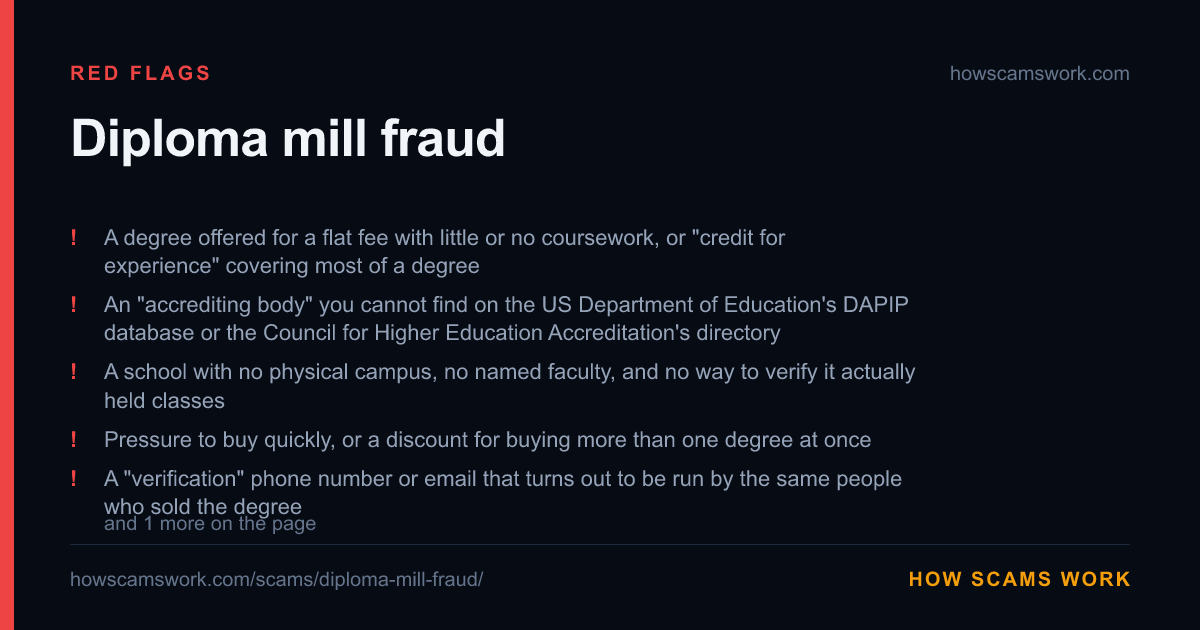
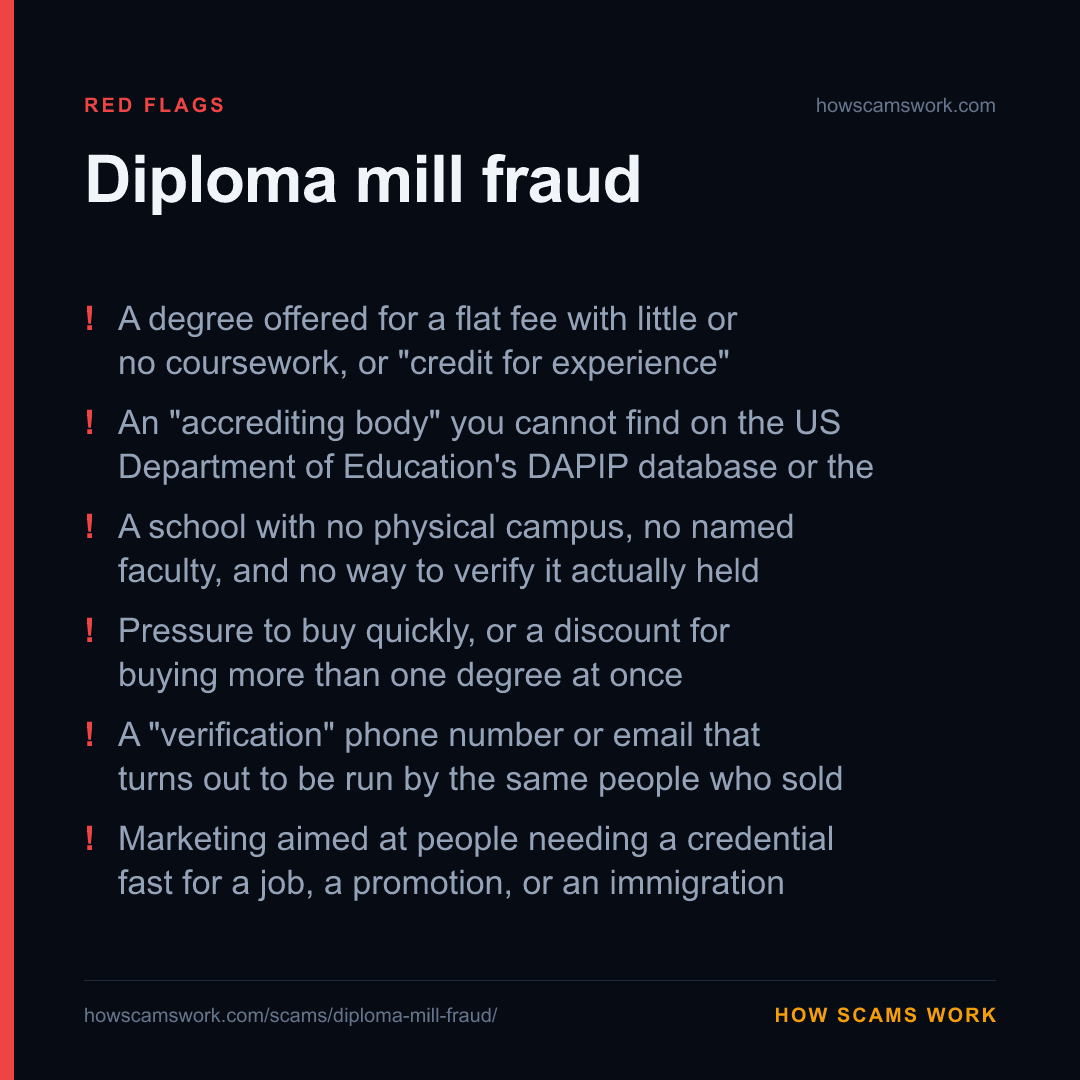
- A degree offered for a flat fee with little or no coursework, or “credit for experience” covering most of a degree. No lawful accredited program works this way.
- An “accrediting body” you cannot find on the US Department of Education’s DAPIP database or the Council for Higher Education Accreditation’s directory. This single check caught every fake accreditor described on this page.
- A school with no physical campus, no named faculty, and no way to verify it actually held classes.
- Pressure to buy quickly, or a discount for buying more than one degree at once. A real university does not sell degrees in bulk.
- A “verification” phone number or email that turns out to be run by the same people who sold the degree, rather than an independent registrar.
- Marketing aimed at people needing a credential fast for a job, a promotion, or an immigration application, rather than at anyone wanting an actual education.
If it’s happening to you
If you were sold a fake degree and have used it for a job, a license application, or an immigration
filing, speak to a lawyer before doing anything else. None of the documented cases on this page charged a
buyer, but your own legal exposure depends on specific facts a lawyer, not a government hotline, should help
you assess first.
If you are an employer, a licensing office, or a visa officer verifying someone’s degree, check the
school and any accrediting body it claims against two free public tools:
- The Department of Education’s DAPIP database (ope.ed.gov/dapip), which lists accredited
postsecondary institutions and the agencies recognized to accredit them.
- The Council for Higher Education Accreditation’s own directory of recognized accreditors and the
schools they accredit.
- Contact the school’s registrar directly, using a phone number or email address you find
independently, not one supplied by the applicant or printed on the transcript itself, since a fake
verification desk is a documented tactic on this page.
- Report suspected diploma mill fraud to Homeland Security Investigations’ tip line at
1-866-347-2423 or ice.gov/webform/hsi-tip-form, since several documented cases here were investigated by
HSI. See where to report for agencies outside the United States.
Where the money goes
Straight from the buyer to the operator, with the size of any further laundering chain tracking the size of
the operation.
At the smaller end, Enowitch’s $5 million in sales simply became his own personal profit, more than
$700,000 of it, with no laundering chain described in the documented sources. At the larger end, prosecutors
alleged the Randocks’ operation laundered a six-figure to seven-figure sum through its own accounts (the
original indictment’s money-laundering count named $1,026,874.80; a later account of the case put the
total closer to $2 million), and Axact’s US-facing payments moved through US bank accounts held by
shell entities, the same structuring technique this site’s other pages describe for hiding the size and
origin of a cash flow, used here mainly to keep a Pakistani company’s American revenue collectible rather
than to launder criminal proceeds in the traditional sense.
What came back the other way, after each prosecution, was forfeiture: Hamid was ordered to forfeit
$5,303,020, a small fraction of Axact’s reported $140 million take. That money goes to the US Treasury’s
Assets Forfeiture Fund, not to any individual buyer, since the buyers in these cases are not a discrete
class of people who lost money against their will the way a romance scam or an investment fraud victim did.
By the numbers
No published dataset breaks this scheme out as its own category yet, so there is no chart to show.
The data page explains which agency categories exist and why some schemes are
invisible in official statistics.
Every factual claim above traces to one of these. Statistics are reported losses; see
methodology for what that does and does not measure.