Also called: telehealth Adderall mill · online stimulant prescription mill · subscription ADHD telehealth fraud · Done Global Adderall scheme
A subscription telehealth app offers a fast ADHD diagnosis and an Adderall refill for a flat monthly fee, pays prescribers by how many patients get a prescription rather than for real care, then bills Medicare, Medicaid and insurers on those same prescriptions. Two Done Global executives were convicted; a prescriber and a second platform, Cerebral, were separately charged and fined.
What it is
A subscription telehealth app promises a fast diagnosis of attention deficit hyperactivity disorder
(ADHD) and a prescription for Adderall or another stimulant, often for a flat monthly fee. The fraud
described on this page is not that telehealth ADHD care exists, federal rules relaxed the in-person exam
requirement during the COVID-19 pandemic specifically to make real care easier to reach. It is that some
platforms paid or pressured prescribers to write stimulant prescriptions by volume rather than medical
need, then billed Medicare, Medicaid and private insurers on those same prescriptions.
Federal prosecutors have called one resulting case the Justice Department’s first criminal drug
distribution prosecution of a telemedicine provider. Done Global’s founder and CEO, Ruthia He, and
its clinical president, David Brody, were convicted in November 2025 and sentenced in July 2026.
How it actually works
The pitch
A social media ad or app listing promises a same-day ADHD diagnosis and a stimulant prescription for a
flat monthly fee, commonly advertised around $79 a month.
The intake
A short video or audio call, or in some cases none at all, stands in for a real evaluation. The Justice
Department’s December 2025 indictment of Done Global alleges prescriptions were issued “sometimes based
solely on a short video or audio communication and limited patient intake documents, or without any video
or audio communication at all.”
Prescribing by volume, not need
Prescribers are paid by how many patients receive a prescription, not by time spent or visits held, and
told to prescribe stimulants even when a patient does not meet diagnostic criteria.
Where it could have stopped
A legitimate ADHD diagnosis requires meeting the criteria in the Diagnostic and Statistical Manual of Mental Disorders, and a prescriber is supposed to be paid for the visit, not for the prescription. A platform that ties a prescriber’s pay to how many patients get a script, rather than to the visits themselves, has already built an incentive against saying no.
Working around a blocked pharmacy
By 2023, the indictment says, some pharmacies had started refusing to fill prescriptions tied to Done
Global. Prosecutors allege the company incorporated a second entity, Mindful Mental Wellness P.A., to
keep prescriptions moving once pharmacies began blocking the first one.
Billing the program
Claims are submitted to Medicare, Medicaid and commercial insurers for prescriptions that, prosecutors
allege, lacked a legitimate medical purpose, while the platform allegedly concealed the prescribing
problem from both the pharmacies filling the orders and the insurers paying for them.
Scaling on advertising
Tens of millions of dollars in social media advertising drive subscriber growth, revenue and, prosecutors
say, the company’s own valuation, which one report put at a goal of more than $1 billion for Done Global.
Enforcement, years apart
A civil settlement for one platform and a years-long criminal case for another move on very different
timelines: Cerebral’s non-prosecution agreement closed within about two and a half years of its own
remedial action, while Done Global’s executives were arrested in mid-2024, convicted in late 2025 and
sentenced in mid-2026, more than two years after the first charges, and the company itself was not
indicted until after its executives were already convicted.
Why it works
The need is real. ADHD is a genuine, often disabling condition, and in-person psychiatric care can
mean a long wait and a high cost. A platform promising a fast, convenient diagnosis is answering a real
problem for many legitimate patients at the same time as it serves the fraud.
The pandemic-era exam exemption was built for a good reason, and is hard to tell apart from its abuse
from the outside. The rule letting a clinician prescribe a controlled substance without a prior
in-person exam exists so people do not lose access to ongoing medication. A platform that leans on the
exemption to skip a real evaluation altogether looks, to a patient or a pharmacist, almost identical to
one using it as intended.
Paying by the prescription, not the visit, inverts the clinician’s incentive. The Justice Department
alleges Done’s prescribers were paid based on how many patients received a script, which the indictment
says left little room for a prescriber to be compensated for simply spending time with a patient who did
not need one.
A subscription fee looks like an ordinary business, not a crime. Patients pay a flat monthly charge
for what reads as a legitimate medical service, while the platform separately bills insurers on the same
prescriptions, two income streams from the same conduct.
Scale outran the people meant to catch it. Done Global alone is accused of arranging more than 37 to
40 million pills (the exact figure cited rose and fell slightly between the indictment and sentencing
stages) before the first arrests in mid-2024, years after regulators began asking questions.
Where it comes from
Entirely domestic, built on a pandemic-era regulatory change rather than hidden from view.
The Ryan Haight Act’s telemedicine exception made this possible. Before the COVID-19 public health
emergency, federal law generally required at least one in-person medical evaluation before a clinician
could prescribe a controlled substance. Emergency telemedicine flexibilities suspended that requirement,
and the platforms on this page built their entire prescribing model around the gap it opened.
Regulators moved on the companies years apart from each other, and years after the conduct began.
The DEA investigated Cerebral’s prescribing practices as early as 2022; Cerebral’s own remedial action,
including firing its CEO, began that May. Cerebral settled civilly in November 2024. Done Global’s
founder and clinical president were not arrested until June 2024, not convicted until November 2025, and
not sentenced until July 2026, and the company itself was indicted alongside a Florida medical practice
only in December 2025, after its executives had already been convicted.
When one route closes, prosecutors allege a platform opened another rather than stopping. The
December 2025 indictment accuses Done Global of incorporating a second company, Mindful Mental Wellness
P.A., specifically to keep prescriptions flowing once pharmacies started blocking the first one.
Enforcement has used both civil and criminal tools on the same underlying conduct. Cerebral avoided
criminal charges through a non-prosecution agreement and a fine its own filings said it could not fully
pay; Done Global’s individual executives faced felony drug distribution and health care fraud charges
carrying up to 20 years each.
Real cases
2024 US Settled $3.6m
Cerebral Inc., a digital mental health telehealth company, agreed in November 2024 to pay more than $3.6 million and entered a non-prosecution agreement with the Justice Department over allegations it used prescribing metrics and financial incentives to push providers toward writing more Adderall and other stimulant prescriptions. A further $2.9 million fine was deferred because Cerebral said it did not have the ability to pay it. Cerebral avoided criminal charges under the agreement.
Read the case file ·
1 source
2024 US Sentenced $12.0m
Ruthia He, founder and CEO of the San Francisco telehealth company Done Global, and David Brody, its clinical president, were arrested in June 2024 over a scheme prosecutors say arranged the prescription of more than 37 million Adderall pills, obtaining over $90 million in revenue and costing insurers more than $12 million. A federal jury convicted both in November 2025, and both were sentenced in July 2026: He to 72 months in prison and a $1 million fine, Brody to 24 months and a $1 million fine.
Read the case file ·
6 sources
2024 US Charged (allegation, not conviction) $800,000
Erin E. Kim, a nurse practitioner with an office in Windermere, Florida, was indicted in June 2024 on charges of distributing controlled substances and conspiring to do so. Prosecutors allege that from 2021 to 2023, while working for the telehealth company Done, she prescribed around 1.5 million Adderall pills and was paid more than $800,000, often without examining patients. These are allegations; no trial outcome has been reported, and Kim is presumed innocent unless and until convicted.
Read the case file ·
1 source
Red flags
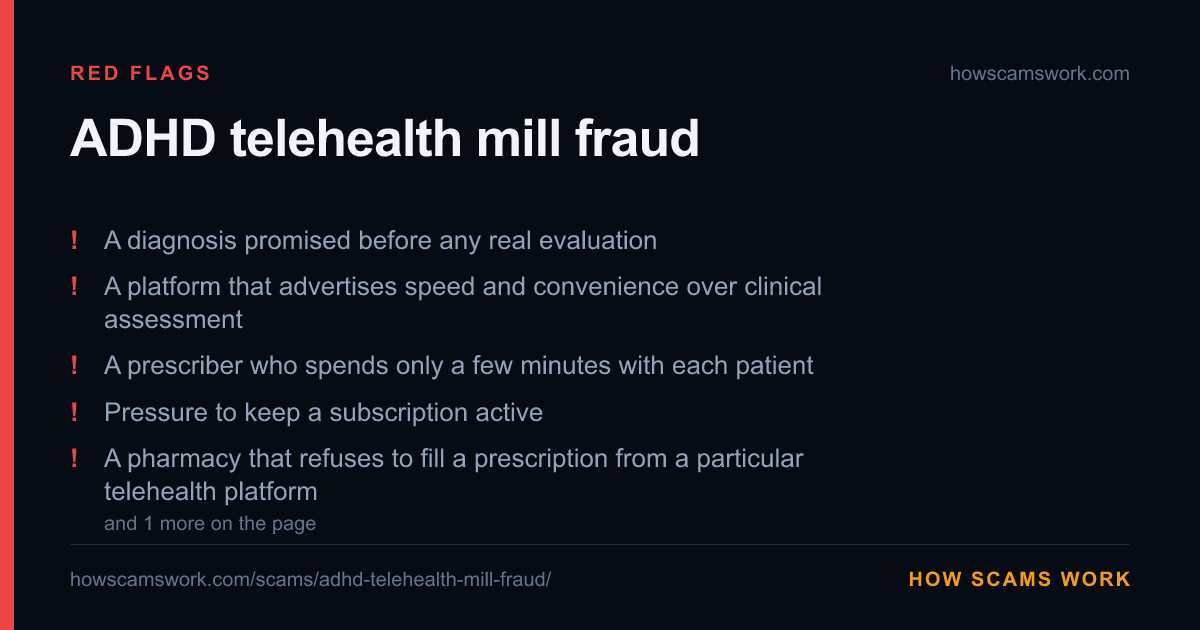
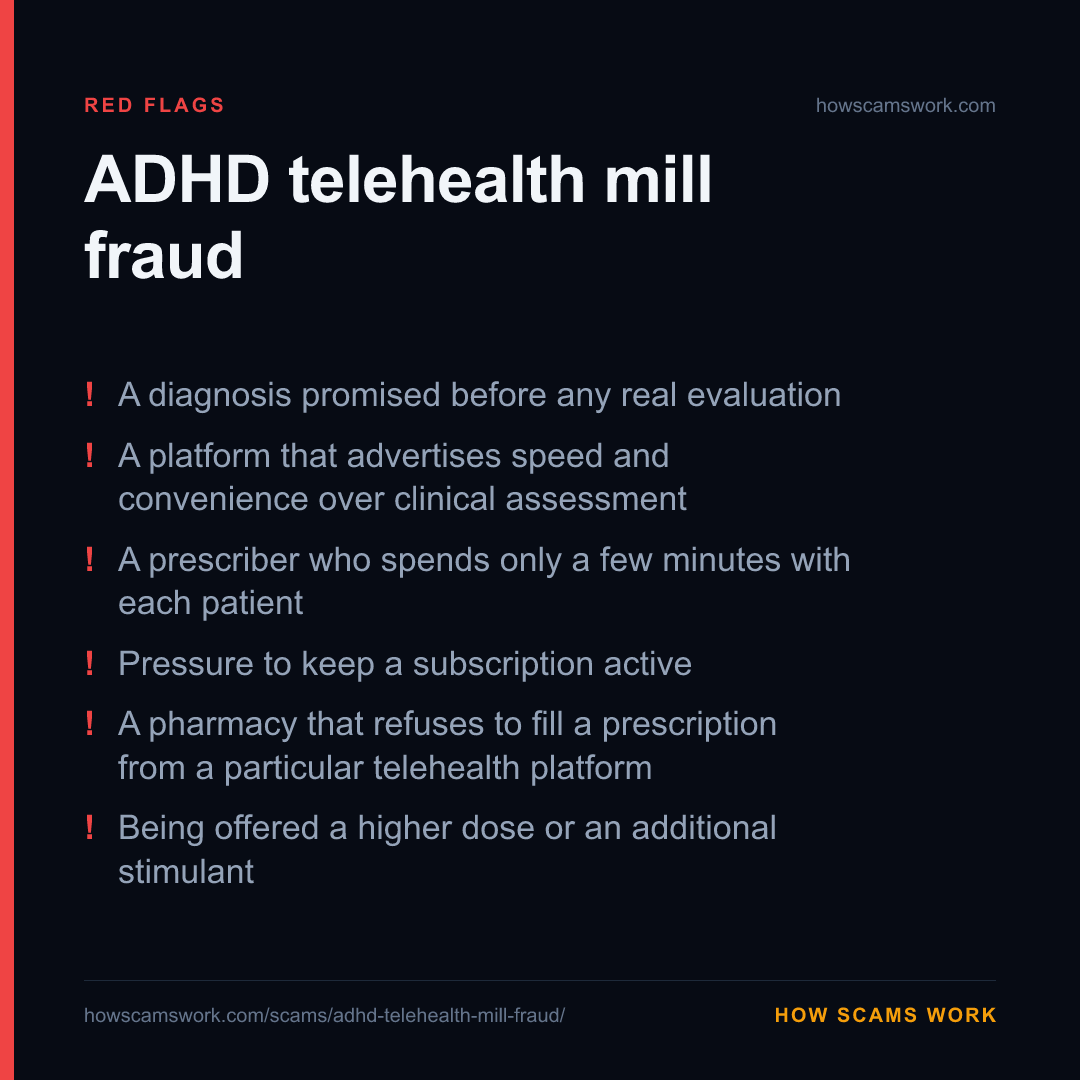
- A diagnosis promised before any real evaluation, especially a prescription offered after a single short video or audio call, or none at all.
- A platform that advertises speed and convenience over clinical assessment, “diagnosed in minutes” or “medication shipped this week.”
- A prescriber who spends only a few minutes with each patient and does not ask about alternatives, side effects, or follow-up.
- Pressure to keep a subscription active to keep receiving refills, rather than a standard prescription renewal process.
- A pharmacy that refuses to fill a prescription from a particular telehealth platform, which can be a sign the pharmacy itself has flagged a pattern.
- Being offered a higher dose or an additional stimulant without a corresponding change in symptoms or a documented reason.
If it’s happening to you
If you were prescribed a stimulant through a telehealth platform and are concerned about how it was
issued:
- Ask for your own medical records, including the notes from your evaluation. A legitimate diagnosis
should be documented against recognised diagnostic criteria, not just a prescription.
- Talk to an in-person prescriber before stopping or changing a stimulant medication on your own;
abruptly stopping some ADHD medications can cause withdrawal effects, and the clinical problem (if the
diagnosis was real) does not go away because the platform that issued it is under investigation.
- Check your insurance’s Explanation of Benefits for claims tied to visits or prescriptions you do
not recognise.
- Report suspected fraud to the HHS Office of Inspector General or the DEA’s Diversion Control
Division if you believe a prescription was issued without a real evaluation. See
where to report.
- If a platform you used is later named in an enforcement action, keep your own prescription and
billing records; patients are not accused of wrongdoing in any of the cases on this page, but your
records may matter if your care needs to transfer to a new provider.
Where the money goes
Two separate streams, from the patient and from the insurer, both into the platform, and both are part of
why this scheme pays even when individual patients are never charged a large amount.
A patient’s monthly subscription fee is the visible, legitimate-looking charge. The larger money, in the
cases on this page, came from billing Medicare, Medicaid and commercial insurers on the same
prescriptions: Done Global’s scheme is put at over $12 million in insurer loss at sentencing, against a
reported $90 to $100 million in total company revenue across its advertising-driven subscriber base.
Years later, enforcement claws back only a fraction of that, and not as restitution to patients or
insurers: a $1 million fine each for Done Global’s two convicted executives, on top of prison time, and a
$3.6 million payment from Cerebral under a civil agreement that let the company avoid criminal charges
entirely.
By the numbers
No published dataset breaks this scheme out as its own category yet, so there is no chart to show.
The data page explains which agency categories exist and why some schemes are
invisible in official statistics.
Every factual claim above traces to one of these. Statistics are reported losses; see
methodology for what that does and does not measure.