Compounded prescription fraud

Also called: compounding pharmacy fraud · TRICARE compound drug fraud · pain cream fraud · compounded cream kickback scheme

Compounded prescription fraud bills a health plan for custom-mixed creams and other drugs that patients often never needed or asked for, with the pharmacy choosing whichever formula pays most and giving recruiters and prescribers a cut. A Mississippi pharmacy co-owner got 18 years in 2021 and was ordered to repay $287.7 million.

Key facts

Category
Business & payments
First documented
2012
Typical loss
$10000k–$287000k USD, per victim
Main channels
cold calls offering free compounded medications, paid recruiters who collect insurance details, prescriptions signed by doctors who did not consult the patient, medications mailed to the patient's home, waived or reduced copayments
Who is targeted
TRICARE, the health program for US service members, retirees and their families, which Military.com reported was billed between $400 and $10,000 per compounded prescription at the scheme's peak; The Labor Department's workers' compensation program for injured federal workers (OWCP), billed in the Houston case; Service members and family members who were cold-called, or who received expensive medications in the mail that they had not ordered; Private health plans and employee health benefit plans, such as the one for Amtrak employees billed in the California case
Documented origins
United States
Main targets
United States
Case files
4 documented cases
Last reviewed
2026-11-03
Anatomy of a compounded prescription fraudAnatomy of a compounded prescription fraud. A health plan that pays thousands for custom-mixed creams, a pharmacy that picks the formula by payout, and recruiters paid to find the patients. 1. A payer that reimburses compounds generously: TRICARE paid $259 million for compounded prescriptions in 2013, more than $250 million above a decade earlier, and pharmacies billed between $400 and $10,000 per prescription, according to Military.com. 2. The formula is chosen for the payout: The Justice Department said the Houston defendants chose compounds based on the amount of reimbursement, not the patients' medical needs; Mississippi prosecutors said formulas were adjusted to get the highest reimbursement. 3. Recruiters find the patients: Marketers made cold calls promising free compounded medications. In some cases the plan member was never contacted and simply received expensive medication in the mail. 4. A prescriber signs without a real exam: In the Arkansas case a doctor signed prescriptions without consulting the patients, and a medical assistant was paid usually $1,000 per prescription to file them under the doctor's name. 5. The patient's share of the cost disappears: Walters's pharmacies routinely waived or reduced copayments and used a purported copayment assistance program to make it look as if they were collected. 6. The plan pays and the kickbacks follow: The pharmacy is reimbursed, then pays marketers: up to 50 percent of TRICARE reimbursements in California, more than $2 million to recruiters in Arkansas, and percentage commissions in Mississippi. 7. The payer reacts, and prosecutions follow for years: The Pentagon moved to restrict coverage in 2015. Sentences continued: 18 years in Mississippi in 2021, 20 years in Houston in 2023, and 60 months in Texas in 2025 for claims submitted from 2014 to 2016. The diagram marks stage 5 as the point where the scheme can still be stopped: TRICARE and the other plans required medical necessity, a physician examination and collected copayments. Each requirement was met on paper, or waived, rather than in fact. The copayment is the one moment the patient was supposed to be told what was being bought.Anatomy of a compounded prescription fraudA health plan that pays thousands for custom-mixed creams, a pharmacy that picks the formula by payout, and recruiters paid to find the patients.1A payer thatreimburses compoundsgenerouslyTRICARE paid $259 millionfor compoundedprescriptions in 2013, morethan $250 million above adecade earlier, andpharmacies billed between$400 and $10,000 perprescription, according toMilitary.com.Years2The formula is chosenfor the payoutThe Justice Department saidthe Houston defendantschose compounds based onthe amount ofreimbursement, not thepatients' medical needs;Mississippi prosecutorssaid formulas were adjustedto get the highestreimbursement.Ongoing3Recruiters find thepatientsMarketers made cold callspromising free compoundedmedications. In some casesthe plan member was nevercontacted and simplyreceived expensivemedication in the mail.Ongoing4A prescriber signswithout a real examIn the Arkansas case adoctor signed prescriptionswithout consulting thepatients, and a medicalassistant was paid usually$1,000 per prescription tofile them under thedoctor's name.Per prescription5The patient's shareof the costdisappearsWalters's pharmaciesroutinely waived or reducedcopayments and used apurported copaymentassistance program to makeit look as if they werecollected.Per claim6The plan pays and thekickbacks followThe pharmacy is reimbursed,then pays marketers: up to50 percent of TRICAREreimbursements inCalifornia, more than $2million to recruiters inArkansas, and percentagecommissions in Mississippi.Monthly7The payer reacts, andprosecutions followfor yearsThe Pentagon moved torestrict coverage in 2015.Sentences continued: 18years in Mississippi in2021, 20 years in Houstonin 2023, and 60 months inTexas in 2025 for claimssubmitted from 2014 to2016.YearsWhere it can still be stopped: stage 5TRICARE and the other plans required medical necessity, a physician examination and collected copayments. Each requirement was met on paper, or waived, ratherthan in fact. The copayment is the one moment the patient was supposed to be told what was being bought.Stages drawn from Justice Department releases on the Houston, Mississippi, California, Arkansas and South Florida cases, an HHS-OIG summary of the 2025 Texas sentencings, and Military.com's 2019 overview of the TRICARE compounding fraud. Accessed 3 November 2026.howscamswork.com
The stages of the scheme, in order, with the point where it can still be stopped.

What it is

A compounded medication is mixed to order by a pharmacist rather than sold off the shelf. That is a real and legitimate service, used when an FDA-approved product does not meet a patient’s needs. It is also a product with no fixed shelf price, and in the scheme documented here, health plans paid very large amounts for it. Military.com reported that at the peak, pharmacies billed between $400 and $10,000 per prescription for pain creams, scar creams and similar products marketed to TRICARE members.

Compounded prescription fraud is the use of that opening. A pharmacy, or a network around it, finds people with generous health coverage, gets prescriptions written for compounds chosen for their payout rather than for the patient, mails them out, and pays the people who found the patients. The documented cases involve TRICARE, the Labor Department’s workers’ compensation program, CHAMPVA and private plans.

How it actually works

  1. A payer that reimburses compounds generously

    TRICARE paid $259 million for compounded prescriptions in 2013, according to Military.com, more than $250 million above what it had paid a decade earlier. A 2014 Government Accountability Office report flagged the growth. For pharmacies, the generous rate was the whole opportunity.

  2. The formula is chosen for the payout

    The Justice Department said the Houston defendants “chose the particular compounds and other drugs based not on the patients’ medical needs but in light of the amount of reimbursement.” In the Mississippi case, prosecutors said the group adjusted prescription formulas to ensure the highest reimbursement without regard to efficacy.

  3. Recruiters find the patients

    Marketers solicited beneficiaries through cold calls that promised free compounded medications, according to the California release. Military.com described campaigns that included Craigslist posts and marketers setting up near military bases. In some cases the beneficiary was never contacted at all and simply received expensive medication in the mail.

  4. A prescriber signs without a real exam

    In the Arkansas case, prosecutors said a doctor would sign off on the necessary prescriptions “without ever consulting the patients,” and a medical assistant was paid usually $1,000 per prescription to file them under the doctor’s name. In the Houston case, the Justice Department said kickbacks were paid to physicians to prescribe.

  5. The patient’s share of the cost disappears

    Walters’s pharmacies routinely waived or reduced beneficiaries’ copayments and used a purported copayment assistance program to make it look as if the copayments were being collected. With no bill to pay, the patient had little reason to question a package of creams.

    Where it could have stopped

    TRICARE and the other plans required that medications be medically necessary, that beneficiaries be examined by a physician and that the pharmacy collect co-payments. Each requirement was a check, and each was met on paper, or waived, rather than in fact. The copayment is the one moment the patient was supposed to be told what was being bought.

  6. The plan pays and the kickbacks follow

    The pharmacy bills the plan and receives the reimbursement. In the California case it paid marketers up to 50 percent of what TRICARE reimbursed; in Arkansas the promoter paid recruiters more than $2 million; in Mississippi, recruiters earned commissions based on a percentage of the reimbursements.

  7. The payer reacts, and prosecutions follow for years

    The Pentagon moved to restrict TRICARE’s coverage of compounded medications in 2015, after the Defense Health Agency’s losses topped nearly $1.5 billion in the first half of that year, Military.com reported. Sentences have continued since: April 2023 in Texas, a 2022 case in Florida, and May 2025 for a Texas pharmacy whose claims were submitted from 2014 to 2016.

Why it works

The payment rate rewards the formula, not the patient. When a pharmacy can choose which compound to make, and the plan pays thousands for some, the pharmacy has every reason to choose the one that pays most. The Justice Department said exactly that of the Houston defendants.

The kickback needs the margin. Paying a recruiter up to half of the reimbursement is possible only when each claim is worth a lot. The documented kickbacks, from $1,000 per prescription to a percentage of every payment, were funded by the plan’s own generosity.

The patient is a signature, not a participant. Several documented cases did not need a willing patient at all. In California some beneficiaries received medications they had not ordered; in Arkansas the prescriptions needed only enough insurance details to fill out the forms.

Waiving the copay removes the one cost the patient would feel. The Walters pharmacies waived or reduced copayments and used a purported assistance program to hide it, so there was no bill to prompt a question.

It spreads through a network, not one person. The Houston case alone named pharmacy owners, pharmacists, a physician and patient recruiters. Military.com reported that at least 100 pharmacies were involved nationwide, and Arkansas shows how a promoter in one state could supply a pharmacy in another.

Where it comes from

This is a US scheme built on US federal health programs. The documented conduct ran from about 2012 to 2016, and prosecutions have followed for years.

Scale runs from a few million dollars to hundreds of millions. Arkansas involved over $10 million in prescriptions; California, over $13 million in claims; Florida, an approximately $88 million loss to TRICARE and CHAMPVA; Houston, the Justice Department’s $126 million headline; Mississippi, more than $287 million.

The recruiter was often the outsider. The Arkansas promoter’s recruiters lived in Arkansas, Tennessee and Texas, while the pharmacy he promoted was in Mississippi. Military.com reported that active-duty service members, veterans and military spouses also acted as marketers in some cases, and that some were prosecuted.

Enforcement is a coalition. Cases named the Defense Criminal Investigative Service, the FBI, IRS Criminal Investigation, HHS-OIG, and the inspectors general of Labor, Postal Service, Veterans Affairs, Amtrak and the Office of Personnel Management.

Real cases

Houston pharmacy owners and a physician sentenced in a $126 million compounding scheme against workers' compensation and TRICARE

2023 US Sentenced $126.0m

On April 13, 2023 nine defendants were sentenced in the Southern District of Texas for a years-long, multi-state scheme to defraud the Department of Labor's workers' compensation program (OWCP) and TRICARE. The Justice Department titled its announcement a "$126M" compounding fraud scheme. The defendants included three pharmacy owners, a physician, two pharmacists and three patient recruiters. John Cruise, a co-owner of Assurance Consolidated Pharmacy in Spring, Texas, received 20 years; his co-owner LaShonia Johnson received 15 years; Kenny Ozoude, owner of Compounding Solutions LLC, received 10 years; and Dr. James Don Jackson received five years.

Read the case file · 1 source

Arkansas promoter sentenced to 36 months for paying recruiters to find TRICARE members for compounded creams no prescriber had discussed with them

2022 US Sentenced $10.0m

Brad Duke, 47, of Little Rock, Arkansas promoted pain creams, scar creams and supplements for a Mississippi-based compounding pharmacy and earned a share of whatever the pharmacy was paid. On May 4, 2022 a federal judge sentenced him to 36 months and ordered him to forfeit $1,055,855.86. The U.S. Attorney's office said that within a year his scheme generated over $10 million in compound drug prescriptions for over 100 TRICARE beneficiaries across the country, that he paid recruiters more than $2 million, and that no one ever consulted a prescriber. Six co-conspirators were sentenced earlier to between 8 and 28 months.

Read the case file · 1 source

Orange County pharmacist sentenced to 70 months for kickback-driven compounded prescriptions billed to TRICARE and Amtrak's plan

2021 US Sentenced $11.8m

Thu Van Le, 42, of Placentia, California, owned TC Medical Pharmacy in Corona. He pleaded guilty on July 12, 2021 to one count of health care fraud and was sentenced on October 4, 2021 to 70 months in federal prison. From March 2015 to December 2016 the pharmacy submitted more than $13 million in claims to TRICARE and to AmPlan, Amtrak's employee health plan, which paid $10,982,759 and $768,488. The court ordered restitution of those amounts. Prosecutors said Le paid "marketers" kickbacks of up to 50 percent of the TRICARE reimbursements.

Read the case file · 1 source

Mississippi compounding pharmacy co-owner sentenced to 18 years in what prosecutors called the state's largest health care fraud

2021 US Sentenced $287.0m

Wade Ashley Walters, 54, of Hattiesburg, Mississippi, a co-owner of numerous compounding pharmacies and pharmaceutical distributors, was sentenced on January 15, 2021 to 18 years in prison after pleading guilty to conspiracy to commit health care fraud and conspiracy to commit money laundering. The court ordered $287,659,569 in restitution and the forfeiture of $56,565,963, which the Justice Department said represented the proceeds he personally derived from the fraud. Prosecutors said the scheme ran from 2012 to 2016 and defrauded TRICARE and private health care benefit programs in an amount exceeding $287 million.

Read the case file · 1 source

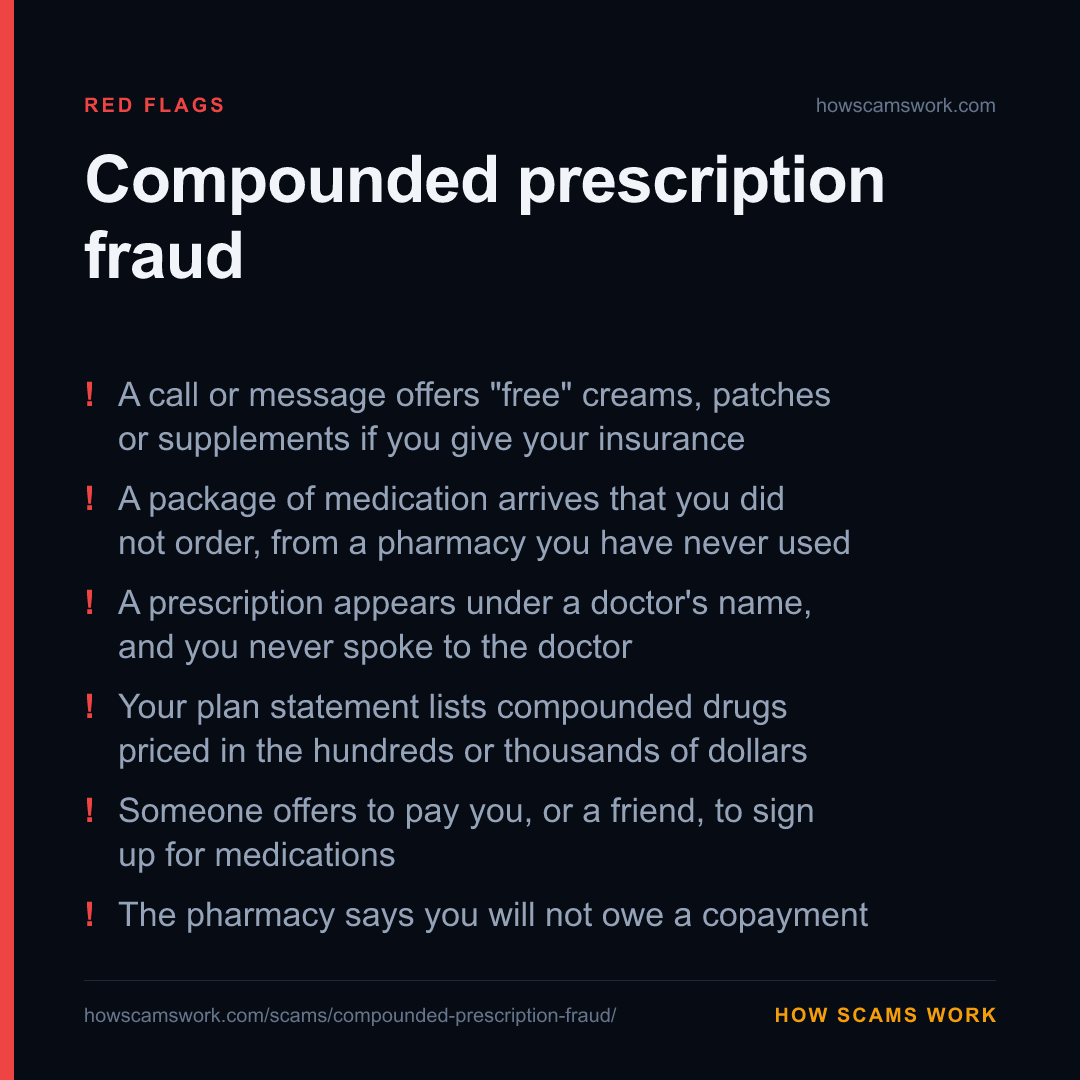
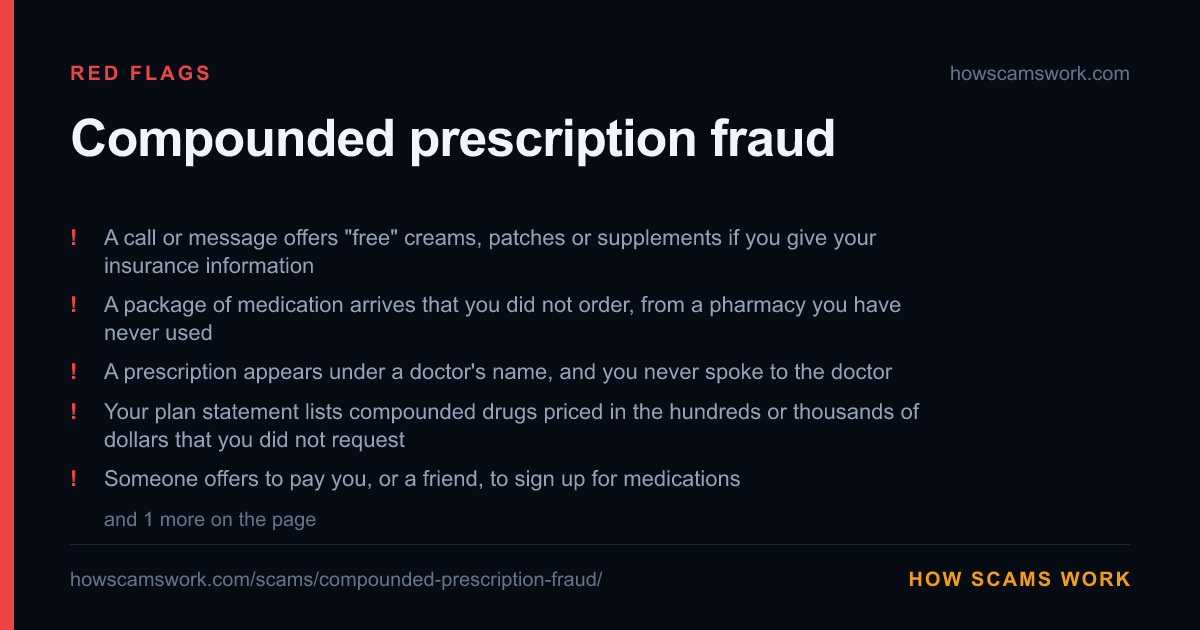
Red flags

  • A call or message offers “free” creams, patches or supplements if you give your insurance information. Several documented schemes started with exactly that kind of cold call.
  • A package of medication arrives that you did not order, from a pharmacy you have never used. In the California case some beneficiaries were not contacted at all.
  • A prescription appears under a doctor’s name, and you never spoke to the doctor. Plans require that beneficiaries be examined by a physician.
  • Your plan statement lists compounded drugs priced in the hundreds or thousands of dollars that you did not request.
  • Someone offers to pay you, or a friend, to sign up for medications. Marketers paid beneficiaries in some cases, according to Military.com.
  • The pharmacy says you will not owe a copayment. Waiving copayments was part of the Walters scheme.

If it’s happening to you

  1. Do not use medication you did not order or discuss with a prescriber. Keep the packaging, label and any paperwork or text messages.
  2. Check your health plan statements for pharmacy claims you do not recognize, and ask the plan to flag the claim as suspected fraud.
  3. Report it. Tell your plan’s fraud line, and report suspected health care fraud to the HHS Office of Inspector General at oig.hhs.gov. See where to report for other countries.
  4. Do not hand your insurance details to a caller or a recruiter. Your plan card is the key the documented schemes needed.
  5. If you are a prescriber or pharmacy employee and asked to sign or fill prescriptions for patients you have not seen, or to change a formula to raise the payment, treat it as a red flag; the Houston and Mississippi cases sentenced physicians and pharmacists as well as owners.
  6. If you took money as a “marketer” or recruiter, consider speaking to a lawyer. Recruiters were sentenced in the Houston and Arkansas cases.

Where the money goes

The plan pays the pharmacy. From there, according to the documented cases, a large share goes straight back out as kickbacks: up to 50 percent of the reimbursement to marketers in California, more than $2 million to recruiters and over $250,000 to a medical assistant in Arkansas, commissions that were a percentage of every claim in Mississippi.

What the pharmacy owner keeps is what courts later try to reach. The Mississippi court ordered Walters to forfeit $56,565,963, which the Justice Department described as the proceeds he personally derived, in addition to $287,659,569 in restitution. In Arkansas, Marshals had already seized $1,055,855.86 from Duke by the time he was sentenced. Recovery comes through forfeiture and restitution orders years after the claims were paid.

The other half of this story

Our sibling site Clean on Paper explains how the first step of laundering moves illicit cash and payments into the financial system. The Mississippi sentence included a conviction for conspiracy to commit money laundering.

By the numbers

No published dataset breaks this scheme out as its own category yet, so there is no chart to show. The data page explains which agency categories exist and why some schemes are invisible in official statistics.

Sources

Every factual claim above traces to one of these. Statistics are reported losses; see methodology for what that does and does not measure.
  1. Nine Defendants Sentenced in $126M Compounding Fraud Scheme. U.S. Department of Justice, Office of Public Affairs (copy hosted by the Department of Labor Office of Inspector General). Accessed 2026-11-03. Supports: The April 2023 sentences of nine defendants, the OWCP and TRICARE victims, the reimbursement-driven choice of compounds, the kickbacks to recruiters and physicians, and the drugs mailed to patients who often never wanted them.
  2. Compounding Pharmacy Mogul Sentenced for Multimillion-Dollar Health Care Fraud Scheme. Oversight.gov, republishing the U.S. Department of Justice release. Accessed 2026-11-03. Supports: Wade Ashley Walters's 18-year sentence, the $287,659,569 restitution and $56,565,963 forfeiture, the 2012 to 2016 period, the formula adjustment, percentage commissions, practitioner kickbacks and copayment waivers.
  3. Pharmacist Sentenced to Nearly 6 Years in Prison for Multimillion-Dollar Compounded Medicine Scam that Defrauded Health Care Plans. Oversight.gov, republishing the U.S. Attorney's Office, Central District of California release. Accessed 2026-11-03. Supports: Thu Van Le's 70-month sentence, the more than $13 million in claims, TRICARE's and AmPlan's payments, the kickbacks of up to 50 percent, the cold calls, the unordered medications and the plan rules.
  4. Ringleader of $10 Million TRICARE Scheme Sentenced. Oversight.gov, republishing the U.S. Attorney's Office, Eastern District of Arkansas release. Accessed 2026-11-03. Supports: Brad Duke's 36-month sentence, the recruiters and the medical assistant who were paid kickbacks, the $10 million in prescriptions for over 100 beneficiaries, and the co-conspirators' sentences.
  5. Former South Florida Pharmacy VP and Executive Assistant Sentenced for Their Roles in Health Care Fraud Scheme Targeting U.S. Military. Oversight.gov, republishing the U.S. Attorney's Office, Southern District of Florida release. Accessed 2026-11-03. Supports: Matthew Smith's seven-and-a-half-year sentence and Alisa Catoggio's five-year sentence, the approximately $88 million loss to TRICARE and CHAMPVA, the $75,106,971 restitution, and the kickback and sham co-pay assistance tracking.
  6. Four Sentenced In $110 Million-Dollar Kickback Conspiracy. U.S. Department of Health and Human Services, Office of Inspector General. Accessed 2026-11-03. Supports: The May 2025 sentences of four people tied to Pharr Family Pharmacy, the more than $110 million in claims submitted from 2014 to 2016, and the 60, 46, 46 and 30 month terms.
  7. It Was the Biggest Scam in Tricare's History. Now Troops May Be Going to Jail. Military.com. Accessed 2026-11-03. Supports: The $400 to $10,000 per-prescription range, the $259 million TRICARE paid for compounded prescriptions in 2013, the Pentagon's 2015 restriction, the 74 sentenced and 50 awaiting sentencing as of May 2019, and the cold-calling and on-base marketing.

Common questions

Are compounded medications themselves a scam?

No. Compounded drugs are tailor-made products that doctors may prescribe when an FDA-approved alternative does not meet a patient's needs, as the Justice Department's California release puts it. The fraud on this page is not the existence of compounding; it is pharmacies and middlemen choosing formulas for what they pay and prescribing them to people who did not need them.

I got a package of creams or pills from a pharmacy I never contacted. What should I do?

Do not use them, and check your health plan statements for claims you do not recognize. In the California case documented here, some beneficiaries were not contacted at all and simply received expensive medications they had not ordered. Report it to your plan's fraud line, and to the HHS Office of Inspector General.

Why would a patient go along with it?

The offers were pitched as free. The Walters case describes pharmacies that waived or reduced copayments and used a purported copayment assistance program to make it look as if they were collected, so the patient was never shown a cost. This page does not claim every patient understood what was happening; the California release says some were never contacted at all.

How many people have been prosecuted?

Military.com reported in 2019, citing the Justice Department, that 74 people had been indicted and sentenced in the nationwide TRICARE compounding fraud, with 50 more convicted and awaiting sentencing, and at least 100 pharmacies involved. Cases were still being sentenced in 2025, when a Texas pharmacist who submitted more than $110 million in claims from 2014 to 2016 received 60 months.

Is this still happening?

The conduct documented here dates from about 2012 to 2016, and the Pentagon moved to restrict its coverage of compounded medications in 2015. Prosecutions have continued years afterward. This page found no source describing new large-scale schemes after the coverage change, and it does not claim any.

Where a compounded prescription payment actually goesWhere a compounded prescription payment actually goes. A large share is paid straight back out as kickbacks before the pharmacy owner keeps anything. Where a compounded prescription payment actually goesA large share is paid straight back out as kickbacks before the pharmacy owner keeps anything.TRICARE, a workers'compensation programor a private planIn the California caseTRICARE paid$10,982,759 and asecond plan paid$768,488 on more than$13 million in claimsThe compoundingpharmacyMarketers receivedkickbacks of up to 50percent ofreimbursements inCalifornia; inArkansas recruiterswere paid more than $2million and a medicalassistant over$250,000Marketers, recruitersand the people whosign prescriptionsReversibilityA recall is realistically possible only at the first hop, and only in the first hours. After the money is converted it becomes an investigation, not a refund.How the first step of laundering moves illicit payments into the financial system: Clean on Paper, our sibling sitehttps://cleanonpaper.com/how-it-works/placement/What the owner kept is what courts later pursue: a Mississippi court ordered Walters to forfeit $56,565,963, which the Justice Department described as the proceeds he personally derived, plus $287,659,569 in restitution. Figures are from the Central District of California, Eastern District of Arkansas and Southern District of Mississippi releases, republished on Oversight.gov, accessed 3 November 2026. Each case is a separate scheme; the flows are not one chain of payments.howscamswork.com
Where the money goes after it leaves, and where it becomes hard to recover.

Report it

Reporting is what produces the enforcement data on this page. Find the right agency and phone number for your country on the report page. If money moved in the last few hours, call your bank first.